Well our move it finally well over. We still have a few more things we need to pick up for the new apartment, mainly bookcases and bins to put all the junk we have. How in the world we managed to store all this stuff in my tiny 1-bedroom for two years is beyond me. We have literally three times the amount of space of my old apartment, but nowhere to put anything. I guess we were so used to just stuffing things in boxes in the upper part of my closet to really notice how much stuff we have.

This weekend the NTT guys come to see if we can install fiber optic or not. I can't wait for Saturday to come. I just home the day they want to come and actually install it, myself or my husband will be home. I have a majorly busy schedule next month, so who knows.


I would review a Japanese site today, but am still looking for a good next page to review. I need to start a running list of all the sites out there so I can keep better track. Big sites I'd like to review are definitely JapanesePod101 and About.com's Japanese pages, but I want to get my feet wet with more smaller sites first.


In other words, expect a review sometime next week. Most likely sometime on Tuesday. I'm going to spend the rest of my "blogging hour" searching for a list of websites to review.


I will leave you with one promotional thing. If you are serious about studying Japanese, and are in the market for a good kanji dictionary, I completely and totally suggest The Kanji Dictionary. It's a $70 dictionary that is unique in that you can search for a kanji combination (i.e. kanji that comprises of two or more kanji) by ANY kanji in the word. Most make you search by only the first kanji, but if you're not sure on the radical can be difficult. My friends got me this for my 17th birthday and I have now taken it to Japan three times and used it constantly in my college studies. It also has many useful appendices in the back, such as a conversion chart for Japanese calendar years, diagrams of Japanese school and political systems, and many maps of the country.
For those not willing to plunk down $70 on a dictionary, they make a smaller Learner's Dictionary version, usually for $25. My university's Japanese department had several of these for student use. While they don't have as much as the $70 version (they lack a lot of older, rarely-seen kanji), they are still just as useful and as easy to use.

I still prefer to use my big, fat, heavy, can-bash-someone's-head-in $70 dictionary to look up kanji combinations than my designed-for-Japanese-people electronic dictionary. So much easier to use, in my opinion. I wouldn't trade this dictionary in for the world. My first year here in Gifu I thought I lost it, and it heartbroke me, until I went home and found it in a box of stuff I moved out of my old room at college when I graduated. It promptly went back into my suitcase back to Japan.


As I think of more books and dictionaries that I think are useful in studying Japanese, I'll be sure to post links. If I had access to more Japanese textbooks other than the one I used in college and the one I use to teach my husband, I'd also do textbook reviews.
Moving in Japan is always an adventure. Luckily, I was able to get it all done with quite painlessly and quite quickly.

My husband and I got our keys on the 6th and had everything moved out and cleaned up by the 13th, turned in the keys that morning and we were done. AND we should be getting most of our security deposit back. I have to ask the boss exactly how much it was because that dictates how much I'll owe on the new apartment's security deposit.

Only complaints about the new apartment are that it lacks a "washlet" toilet seat (i.e. heated toilet seat that also had butt-washing sprays), and there are no windows in the room we use for our bedroom. However, the latter isn't much of a problem considering if we open one of the sliding doors we get plenty of sun in from the next room over, our living room.

One day, once we get Internet access, I'll post picture of the new place compared to the last. I'll also post pictures of the NTT guys installing fiber optic Internet (yeah, you know you're jealous).


Other news, I completely bombed my Japanese Language Proficiency Test (JLPT). I took the highest level with no studying whatsoever just to see how horrible I'd actually do. Amazingly, I got just around the 40% I thought I would be lucky to get. Only 30% more to go until I pass. Let's see how well I do this coming December!


Anyway, onto the main course! Today, I'll be reviewing a random website I found at work, Free Japanese Lessons.


First impressions: Much, much simpler front page compared to the last website. Straight forward links to all available 10 lessons, videos, chat, and the FAQ. Not flashy, but very straight-forward and easy to navigate. Only downside is the abundance of ads around the front page, but even then they aren't very intrusive. I like the "Today's Kanji" and "Today's Phrase" boxes on the upper right. The link to information about hotels in Japan is also convenient and not something I've seen on many other sites.


Obviously a beginner's website, the first lesson they offer dumps you right into hiragana with a chart of all hiragana, including those with diacritical marks and combinations. It has a short but concise explanation of pronunciation, which with everything considered is actually a pretty decent explanation. Japanese pronunciation isn't that hard once you realize that vowels will never change how they sound no matter what comes before or after them in the word.
A major point for this particular lesson, which I don't think I've ever seen explained on the same page as a hiragana chart, is the pronunciation exceptions for the characters は and へ ("ha" and "he" respectively). Most wait until certain grammar points are learned to bring up the pronunciation exceptions for these two characters, but this site puts it right out there are the beginning to try to defuse any confusion down the line. They also offer a neat little explanation on why these two have second pronunciations, an explanation I actually did not know myself. I was always told in my learning that they are sometimes pronounced differently because "that's just how Japanese is". Their explanation actually makes sense and makes me mutter なるほど (that explains it) under my breath.
They also include the standard explanation of why there are two "zu" and "ji" characters, and also a brief thing on how to know when to use them. All in all, a decent intro to hiragana. Only thing missing is stroke order, which is very important when learning to write. Due to there being no stroke order explanation, I'm guessing this site is more geared towards reading and speaking Japanese, rather than writing.

The next lesson brings you to katakana, which just like hiragana offers nothing but a chart. Also, the explanation about how katakana is used for foreign names and borrowed words is not entirely correct. Yes, katakana is used for foreign names and borrowed words, but it is also used for scientific names of animals and plants, and often as almost a replacement for italics in writing when emphasis is needed/wanted by the writer. However, it is a decent explanation if you're looking for a short-and-to-the-point explanation.

Moving on, we have vocabulary. We're given a very spartan list with a very loose organization. 23 words, including words for "you", "I", "him", "her", "this/that", "here/there", greetings, and random nouns (person, cat, dog, house). While these are all really good things to know, they aren't presented in an easy-to-remember format. Just a list. A list with the kanji, hiragana, romaji, and English meaning. The site does try to explain that there are different types of formalities when dealing with greetings, and offers both forms of "thank you" and "good morning". However, they only offer the casual form of "goodbye", さよなら (sayorana). Formally, it should be さようなら (sayounara).

Lesson 4 brings on grammar, and once again we're looking pretty spartan. The whole page is nothing but explanation about particles, which while are an essential part of Japanese grammar, it is kind of different to see the main 5 listed all together right off the bat. Also, they don't even go into much explanation about へ (e) as a particle. Once again, very basic, very to the point explanations about the remaining four particles, but perhaps too basic. Part of me hopes they go into more details of the particles and how to figure out what is the topic and what is the subject and all that. They do mention that "I" is usually dropped from the sentence in spoken Japanese, due to being implied. This is something many textbooks do not teach, as textbook writers want to make Japanese grammar closer to that of English.

Fifth lesson on the page makes me wonder if the person making this site is just winging it and creating lessons as he goes along. We go from vocab, to grammar, back to vocab. And of all things, numbers, time, days of the weeks and months. Considering how basic this vocabulary is, I would have put it directly after Lesson 3 with the greetings and other basic vocab. Once again, a very spartan list, and instead of listing out a good portion of the numbers, time and months, they give you the start of the "pattern" and tell you to run with it. While they do explain that "4" and "7" both have two pronunciations, they don't go into detail about why you shouldn't use the one pronunciation of "4". For those curious, "4" can be pronounced よん or し ("yon" or "shi"). The pronunciation of "4" as "shi" is avoided a good 60-80% of the time as "shi" also means "death". Because of this, "4" is also an unlucky number. My old apartment complex and my new apartment complex both do not have rooms or parking spots ending in "4". So the first floor rooms go 101, 102, 103, 105.

I really don't have any complaints about the days of the week part of the page. It's straight-forward and simple enough even without a thorough explanation.


Now, back to grammar. Lesson 6 starts off with verb conjugations right away, specifically those of godan verbs. Godan verbs are verbs that the verb stem changes depending on the tense. There are five stem changes, hence the "go" or "five" in the name of the verb type. This site actually sets up their explanation much like my high school sensei did, which for me made it very easy to understand. Only complaint about the whole page is how they explain the conjugation of "te" and "ta" forms. It would be easier to understand with a second chart, rather than just text.
Next lesson continues verbs with ichidan verbs, and once again only gives simple explanations of the conjugations. In their simplicity, the explanations are slightly confusing. They try to compare ichidan verbs with godan by giving them five "bases", or stems. Technically, only have one stem, hence the "ichi" for "one" in the name "ichidan". In their attempt to connect new material with what has already been learned, they actually make it a bit more confusing than it would have been to just introduce them as having only one base, not five. Personally. I would have introduced ichidan verbs first, then godan. But that's me.
Also, their "five base" system of organization they have going on here makes it a bit confusing for the only two irregular verbs in the language. Only really useful thing on this page is a small link to verbs that sound like ichidan verbs but are actually conjugated like godan verbs.


Earlier on, I believe in Lesson 4 or 5, it was mentioned that polite tenses would be discussed in Lesson 8. Well, not really. Yes, they list the polite forms of different verb conjugations, but that's about it. No explanation on when to use them or anything. Also, while they give an explanation for each verb tense, they don't give any examples of how to use them in sentences. And come to think of it, I haven't even seen any explanation about the copula, です (desu) at all. Usually that gets explained way before verbs ever do.

Lesson 9's explanation of adjectives is a bit confusing as well. Not sure where they got "dv" and "dn" for the two types of adjectives in Japanese, but it's something new to me. They mention how "dv" adjectives (commonly called i-adjectives in many textbooks) can be used as adverb and modify nouns, but give no explanation further than that. No examples or anything. They do, however, show how "dn" adjectives (commonly na-adjectives) can be used as adverbs.

Lesson 10 leaves us off at how to introduce yourself to someone and other common phrases. The further I get into the site, the more I start to not like how simple it is. Simple is good, but there are places where it does need more explanation on grammar points. Keeping it too simple misses out on a lot of subtleties in Japanese grammar that need more time and attention.


Overall, a good start to a website. I hope it eventually starts developing into a fuller website, but at this point I'm not keeping hopes up. It's a good place to dip your feet it and get a brief overview of what you're in for when you actually buckle down and start studying Japanese for real.


And that's it for this time. End of this month the NTT guys come on the 28th to check out what they have to do to get fiber optic into the apartment, so hopefully by middle of next month I'll have home access again! Not sure what website I'll do next time, but I'm always up for suggestions.
This week my husband and I move out of our dinky 1K apartment into a nice, spacious 3DK about 5 minutes away. As such, it's been a busy week of prep, and this week we've been moving things back and forth between the two places every day. Tomorrow, movers come for the last of our big stuff (fridge and washing machine), and by Friday we have to be completely out of the 1K and have it cleaner that it was when I moved in two years ago in hopes of getting my security deposit back. I doubt I'll get all of it back, but I'm hoping for a bunch of it back.


Look for another review post up sometime next week. Not sure what page I'll be doing, but look for it anyway.


Till then.
Finally, here we are at the true purpose of this blog: introducing and reviewing "learn Japanese" websites.


Today we'll start with The Japanese Page (TJP).


First, I want to say I am using the office's laptop to view this page, and it won't let me update IE to 7, nor will it play nice with Firefox. I blame my boss for never running an anti-virus on here, so if what I say seems to be different than what you see on your own computers, I apologize in advance.


First impression of the main homepage is cluttered. I seriously don't know where to start. First, half the page is taken up with an ad from the main supporter of TJP (a Japanese pen pal website) . It's a giant text promotional ad calling people to buy a membership to the pen pal site. Takes up a large part of the screen, and runs into the next part of the site. Not sure if it's an introduction to the site or an ad for reading a story in Japanese while listening to it being read in Japanese. Looks like both together.

There's also a login box, a sign up box for a newsletter, a poll, links to articles, ads everywhere, a shoutbox, a list of top posters, etc. And it's all meshed in with poorly placed ads. I can't tell what image is a link to an article and which is an advertisement. One also has to scroll to the bottom of the page to find links to articles separated by level. There are links to the normal website fare of a chat, forum, videos, audio and the like up top, but that's the only thing I find useful on the entire front site.


Clicking on the FAQ link, one has to scroll through rules for the forums before even getting to the main FAQ. However, the FAQ is easy to use, once you get to it, and offers help on how to install the necessary files to both read and type in Japanese on your home computer. It also offers, if you scroll though, some good links to find downloadable audio files and pen pal sites. There are some basic questions about Japanese that are answered in the FAQ, but they don't seem to fit into the section of the FAQ where they are placed.


As for the site's lessons page, this may be the page set up the best on the entire site. Lessons are listed in order of Beginner, Grammar, Kanji, Culture, Vocab, General and fun stuff. It's set up really simply and is easy to figure out what is what, but is it all beginner level stuff? What happened to intermediate and advanced? Does the website not offer those? One may never know from just looking at this page. Clicking on the Beginner link, the beginner "lessons" are no more than a collection of flash cards, video and audio clips explaining simple grammatical concepts or vocabulary, and downloadable podcasts. There seems to be no real set path, no "Try this first" or "Do this next". One just starts with whatever one wants to, it seems. The New to Japanese Advice page gives some hints at where to start, what textbooks you might want to consider, and some reasons to learn Japanese, and finally at the very end it gives a "Try this next" link. There is no real guidance or rhythm to the page or the lessons, but instead encourages visitors to log in and join in the forums, where you can talk to other learning Japanese from TJP and other means, and possibly find help. There are some good links to other sites for resources, but nothing concrete.

Following the link to their 15 Minute Japanese Lesson, however, does give a good introduction to the basics of the language, even if all at once. It's a good page to see what you're getting yourself into, but once again doesn't lead to anywhere. The Japanese Page leaves it completely up to the learner to decide what order and how they want to learn. While this can be beneficial for those who like learning things sporadically, this can be detrimental as learners have no real path to follow in learning. Once you learn how to read and write Hiragana and Katakana, where do you go to learn basic grammar? What if you don't care about reading and writing, but need to get some basic conversation skills down for when those Japanese visitors at work come by next month? There doesn't seem to be any real flow.

The Hiragana and Katakana pages, however, are quite well set up. They break the two writing systems into chapters to make them easier to learn than cramming them all at you at once. It also has sound files to hear how each character is supposed to be pronounced so you can practice mimicking the sounds yourself without guessing what they're supposed to sound like. There are also quizzes and flash card links (only on the Hiragana page) that one can use to test themselves. Overall, the set up of these two pages can be very useful in learning and mastering two of the writing systems in Japanese.


Moving onto the Grammar page, while the Lessons page lists four categories of 3kyuu Grammar (What happened to 4kyuu?), 100 Grammar Points, Word Order, and Particles, clicking on the link to the main page just gives a long, uncategorized list of the available "articles" and lessons within the grammar section of the website. There are two large image links for the 100 Grammar Points section and the 3kyuu grammar section that actually aren't that bad. The 100 Grammar Points is split into 8 chapters, and each chapter is further split into 12-13 subsections, many of which do have some sort of relation between themselves. The 3kyuu page, however, is a bit lacking and is just one long list of links, with no real organization it seems.

Out of all the pages up until now, the Hiragana and Katakana pages were set up the best, by far. However, the Kanji section definitely blows them out of the water. The top of the page offers links to a "Kanji-a-Day node and a Kanji Dictionary via TJP, as well as a small link menu to different sections of the Kanji page. While the link menu is slightly confusing, it's easy to skip over and scroll to the main gist of the site, the kanji lists for all four levels of the Japanese Language Proficiency Test. Levels 4 through 2 offer a list of all the kanji in that level, different subcategories of kanji (usually containing 20 kanji each), quizzes on each set of 20 kanji, a PDF file of all the kanji, a randomizer and flashcards. Level 4 also offers a test on all 80. Sadly, the Level 1 page is unfinished, and only offers about 80% of the kanji required for that level of the proficiency test.
Back at the main Kanji page, under the link to the 4 levels of kanji, there are several useful links, such as stroke order, kanji of Japanese origin, reversible kanji combinations, and country names in kanji. All of these actually can be very useful and are probably one of the best things the whole website has to offer.

After the Kanji page, nothing else lives up. The Vocabulary page is just like grammar, and offers just a giant list of different articles in no particular order. While there do seem to be some useful articles, you might have to search and read through several non-related things before finding what you want. Same with the Culture page. While there is a lot of information, some of which is quite interesting, there's just no order. General Lessons just seems to combine a little bit of everything, mainly from the vocab and culture pages. The Fun page just seems to be a conglomerate of everything that didn't fit into the other pages of "lessons". It does have some quizzes and unusual-but-useful vocab lists, but is mainly just...stuff.


Glancing at the Video page, this may also be up there on the same level as their Kanji page was. Videos are arranged in order of level or subject, with several continuing series of videos. Each section also has three videos shown so you can get a brief idea of what each section involves, making it a bit easier to navigate. However, those with slower computers, such as this laptop, may be in for a wait while all the videos load up. The Audio section offers some audio-only versions of several of the videos, as well as audio files of different traditional songs mentioned throughout the website. There are also links to some Beginner-only Podcasts, and several audio lessons. I'm intrigued mainly by the list of traditional folktales they have for download. These wouldn't be a bad thing to download for real listening practice.


For those who create an account on the site, there are also member-run study groups, forums to ask for advice and help, and user-posted blogs. The groups seem to be their own forum where only members of that particular group can post. They're more to bring people at the same stage of learning together rather than help, it seems. While there are thousands of members in several of the groups, the group with the highest post count only has 34 posts. Seems the action is all in the forums, which, frankly, I am afraid to wander into. I will let you guys decide on that for yourselves.


As a Japanese teacher, I think this site does have a lot to offer, but the set-up is lacking in organization and flow. The kanji lists are useful, and the audio files may be a great way to practice listening skills, but there just doesn't seem to be enough meaningful content. Most of the content seems user-created and is frankly quite amateur. There are other places to get the same information, but more up-front and easier to use.

All in all, I say it's a confusing site to start with, and a confusing site to look for resources. If I had to give it a grade, I'd say no more than a C. It has potential, but is to confusing and tries to do too much all at once with no order whatsoever.
As much as this blog is supposed to be writing reviews and such about the available self-study Japanese websites out there on the tubes, I'm still trying to find my voice by talking about work and work-related subjects.
I've talked about Hop Step Jump, Hop Step Jump events (student-run and company-run), and Learn-Japan.
All the photos I've posted so far have been work-related.
I've been all work, work, work.


So a bit of a break. Before I start cracking down and actually reviewing websites, I want to share Gifu.


The title of today's blog is a well-known quote from the Sengoku (Warring States) Period of Japan's history. The reason being, Gifu is the exact center of Japan. Literally. Geographically. The village of Minami in the northern city of Gujo is actually the dead geographical center of the Japan archipelago. I've been to the museum that has a huge pendulum-looking cone pointing to the exact center. Many of the postal codes in Gifu also start with 500 to signify how central of a location it is. Relative to the "big" cities of Tokyo and Osaka, it's roughly 396km (246 miles) to Tokyo and 217km (135 miles) to Osaka, making it roughly in the middle between two of the largest cities in Japan and the world.

While most in Gifu would consider it inaka (country) here, it's actually a pretty interesting area to live in. In way northern Gifu there's the Hida-Takayama area, known for it's mountains (considered a part of the Central Japanese Alps), sake, and for a large, old-style shopping district in Takayama City. Takayama City is also the largest city in surface area in Japan. There's a famous Shinto matsuri festival in spring and fall that I have been meaning to get to. The whole are gorgeous to go visit any time of the year, especially in fall and winter. They also sell good luck charms called sarubobo, and I have two Hello Kitty sarubobos I bought my first trip there. Sadly, my laptop died two years ago and I lost all of my photos from this area. I need to go again and get some good photos to share.

Nearby Hida-Takayama is Gero, which houses some famous onsen. The onsen has a huge fireworks festival every year that attracts a huge crowd from all over the country.
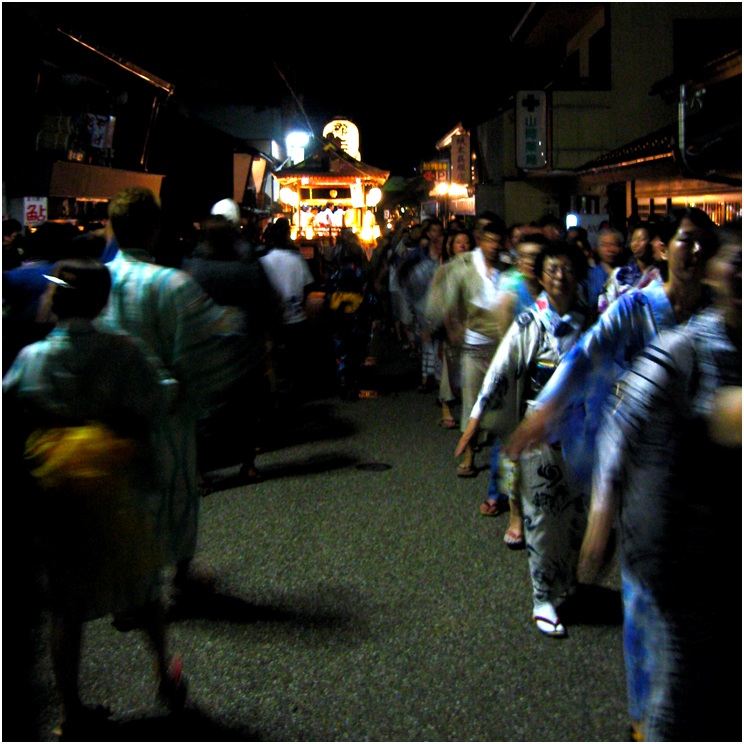
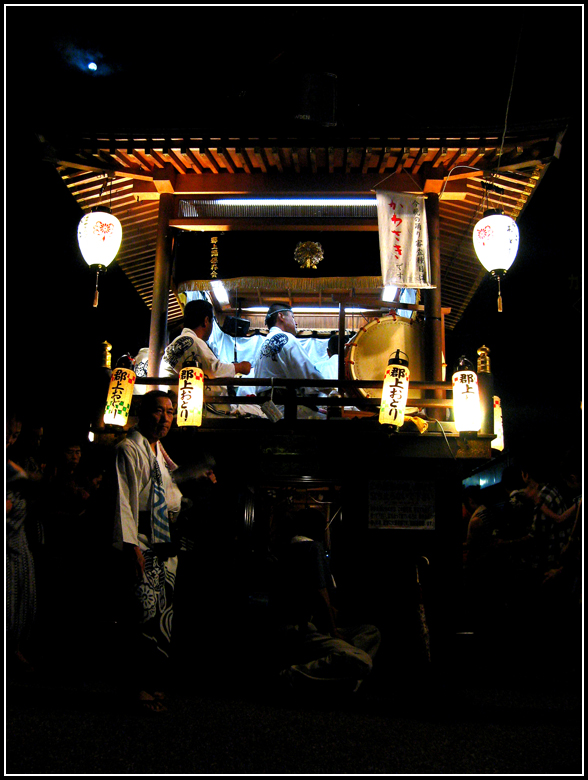
Gujo, which I mentioned further up the page, is west of Gero and is one of my favorite places in Gifu. Gujo is home to Gujo Odori, a huge dance festival in August celebrating the Bon Festival. If you've ever seen a picture of the famous Daimonji in Kyoto, it's for the same holiday. It's held in the Hachiman area of Gujo, and lasts a month. The most amazing part of this festival is in mid-August, usually around the 14th, where for four days the citizens of Hachiman and people form all over the country come to participate in tetsuya-odori, all-night dancing. I've gone two years in a row and plan on making it three this year.
Here are two of my photos from last year:

This is the little pagoda that is in the center of the dancing area. These poor old guys have to sing and play music all night from about 8pm until 4am while people have fun and dance around them.


This is what it looks like in between the dance lines, looking towards the center. Usually the dancers are arranged in a plus shape, snaking down the four streets that create the intersection that the pagoda sits in.


Gujo also houses several caves which are open for tours and are awesome places to hide from the summer heat, as well as a "food replica" factory and store that is open for tours. Gujo-Hachiman actually produces 80% of the plastic food samples you see in restaurant and cafe windows across the country. The factory sometimes offers tours that allows visitors to try their hand at making their own leaf of lettuce to take home with them.

Heading south towards Gifu City brings you to Seki City, which has a 700-year-old history of sword making and cutlery. Four times a year they have demonstrations of the traditional methods of sword making, and also have ceremony for the first sword of the year at New Years. The Swordsmith Museum also houses one of the largest swords in the world, a katana that's a good 6 meters long. The area of Seki, and it's neighboring city of Mino, is pretty well known for unagi, or eel, as well. Makes for a tasty summer treat!

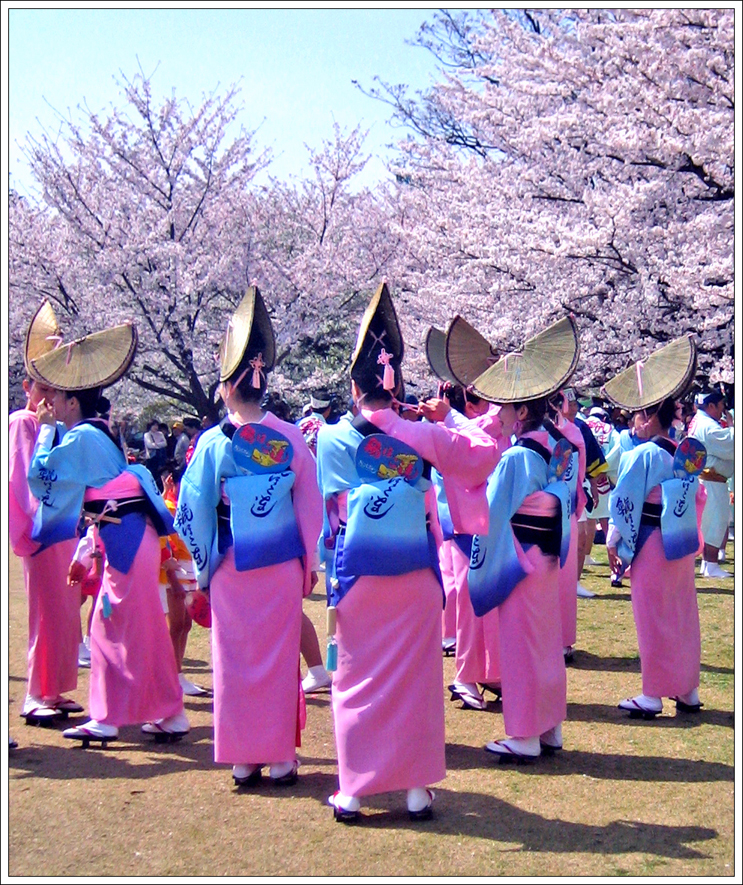
In southern Gifu, the big three cities are the capital, Gifu City, Kakamigahara City, and Motosu City. Kakamigahara, often called Mippara by citizens, houses several aeronautic companies that design and manufacture airplane parts, as well as a Self-Defense Force (formerly the Japanese Army) air base, both of which made the city a common air raid target during World War II. Currently, Kakamigahara is known for it's sakura in the city park and along the river banks.


Motosu City is known for mainly three things: persimmons, Usuzumi-zakura, and MaLera.
Motosu is a large producer of fuyugaki persimmons, and groves of persimmon trees can be seen all over the city. If one asks someone from Gifu what a good gift from Gifu would be in the fall, most will suggest a box of persimmons before anything else.
The Usuzumi-zakura is the oldest sakura in Japan, believed to be over 1500 years old. The park where it is is now filled with many "babies" that have come from the central tree. It is a rare type of sakura that has pale pink blossoms that change to white at full bloom, and fade to a light gray as they fall. The sheer size of it is unlike any sakura I had ever seen. Hopefully I can go this year and actually take photos.
The MALera shopping mall in Motosu opened a few years ago, and is actually one of the largest malls in the country. It boasts 240 retail stores, a movie theater, food court, supermarket, and a "restaurant street" that stays open after the retail stores have closed. It is a paradise for mall-walkers, without a doubt.


Gifu City is where I'm stationed, and is the capital of Gifu Prefecture. It's a pretty decent sized city, and is quite easy to live in. There's a large JR station and one of the main Meitetsu stations in the center of town, as well as a shinkansen station about a 45 minute drive away over in Hashima City. First thing you notice when you get out of the train station is usually Gifu Castle sitting up on top of the mountain. Just as most of them are nowadays, it is a replica museum, but is a nice hike up Mt. Kinka to get there, or you could take the ropeway car up for $6 one way. Inside there is a lot of samurai armor, weapons, ninja weapons (yeah, real shuriken and the like), and a bunch of papers in Latin about a missionary who came during Oda Nobunaga's reign. Nobunaga's a weird historical figure in that he's become quite the legend. Appears in several video games as a "devil" figure, mainly because of how Japanese history portrays him. He was good at killing off those who opposed him, and allowed Christians onto his lands. Both of these got him the lovely title of "evil" when he was finally defeated.

Below the castle are several museums inside Gifu Park, including an insect museum and a city history museum, and down the street is Shōhōji Temple which houses one of Japan's largest Great Buddha statues. One of my co-workers told me it is not only the 3rd largest Buddha in Japan, but also the largest lacquered Buddha in Japan. Within a short walking distance from Gifu Park one will find Inaba Shrine, one of the three largest shrines in Gifu City. Inaba, along with Kogane Shrine and Kashimori Shrine (right down the street from my office), house a "family" of deities, with Inaba and Kogane shrines housing the parent gods, and Kashimori Shrine housing the child of the two. Every year in April the three hold joint festivals. In front of Inaba Shrine, one can also find the local branch of Zenkouji Temple. Seki City, which I mentioned earlier, also has their own branch of Zenkouji Temple which is much older than that of Gifu City.


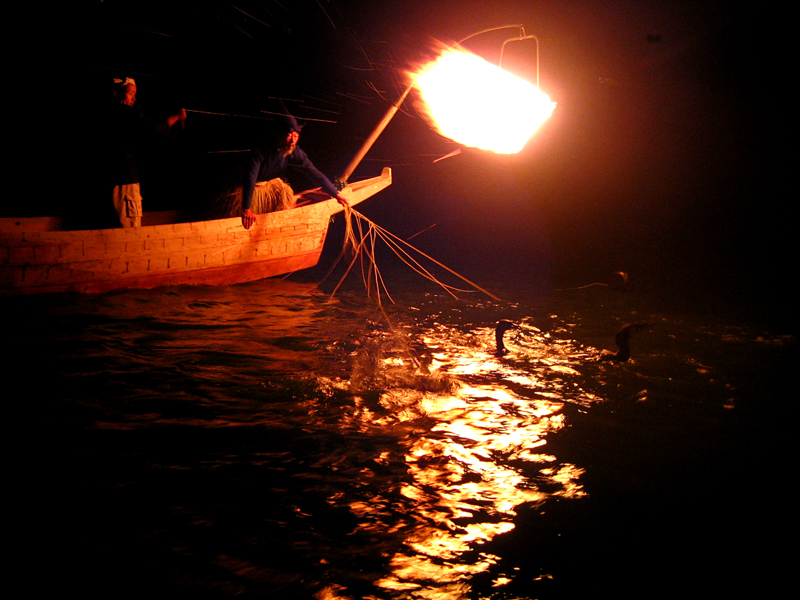
Possibly the most famous tourist attraction in Gifu City is it's historic cormorant fishing, Ukai, that occurs on the Nagara River between May and October. Gifu's section of the Nagara River is one of just a handful of places in Japan where this traditional night fishing still exists. Seki City, Inuyama City in Aichi Prefecture, and an area of Nara are the only places I've heard of that still practice this art. The tradition has been passed down through families, from father to son, for 1300 years. The houses where these families live are preserved as they were from Japan's past. Officially, these fishermen are under the watch of the Imperial Household Agency, and much of the first catch of the season is sent to the Imperial family as a gift. There are also areas of the Nagara River where fishing is prohibited as they are the official fishing spots for where the Imperial Family gets their Ayu, a type of Japanese sweetfish.


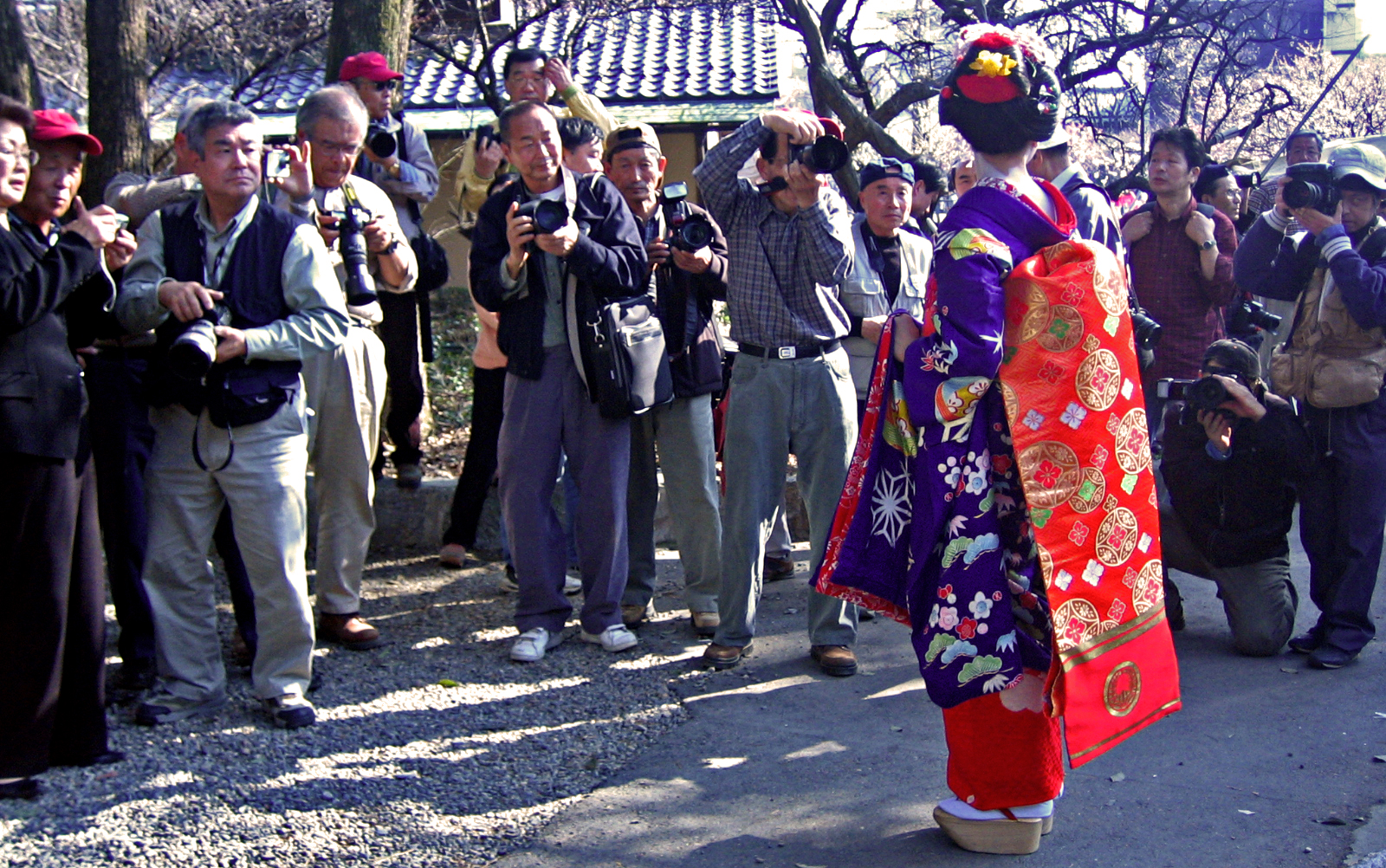
Another must-see in Gifu City, is Bairin Park, which houses 1300 Japanese plum trees. It offers 50 different varieties of plum trees, 600 of which are red or pink blossoms, and 700 are white varieties. A few of the red and pink varieties start blossoming as early as mid-January, and continue well through March. The Bairin Plum Festival, Bairin Ume Matsuri, is held the first weekend of March every year, with food booths selling all sorts of festival food, and local modeling companies bringing in models to pose with the blossoms for amateur photographers. Two years ago we had one model dressed up as a maiko, and last year we just had two girls in pretty dresses. The sheer amount of people with cameras is just amazing. Many also bring portable printers with them to print out their photos right then and there. Going to this festival is one of my favorite parts of living in Gifu, and I can't wait for this year's. Most likely I'll run into every single photographer you see in that above picture.


I could go on and on and on about things to see and do in Gifu, but I think I've droned on long enough. This took me two sessions at work to type all out. One last link I would like to share with you all is The Site of Reversible Destiny in Yoro Park, to the East of Gifu City. There is no other place like this in the world, and it is an incredible experience. It's slightly run down after being open for 10 years or so, resulting in a surreal, almost bad dream-like experience if you go on a cloudy day. I regret not taking my mother while she was here last summer. I think she would have gotten a kick out of it.


This is all my random rambling for now. Starting next month I'll be doing reviews of various websites to learn Japanese from, and possibly different ways to find work in Japan. Have to run that by my boss first.

Till next month!
I must say, it is good to be American.
I cannot wait to see if our new president can truly turn around our country and get the majority of Americans to stop being such ignorant, arrogant idiots.
I really hope my vote doesn't go to waste these next 4 years.


Also, I am excited that this blog has reached over 100 views, while probably 90% are either myself, the office or friends. I am amused that I have had one visitor from Tel Aviv, which is really neat.


Now back to the point of today's blog.
I'm taking a break from the lengthy, drawn-out, no-one-in-their-right-minds-would-want-to-read posts about boring work things to show you photos.
While there aren't many (mainly because I totally forgot to bring extra batteries for my camera), here are are a few photos from HSJ's company shinnenkai that I talked about a while ago.
I apologize for any fuzziness, pixelation, weird colorization or whatnot. I had to adjust these on a work computer which only has Photoshop 5.5. If any are completely terrible, I will change them when I get home.


This is the second year in a row where we held the party at a hotel buffet near Gifu Station.
Every table had teachers of our various languages from various countries, each who brought a dish from their home country. It's the one time of the year where we get close to all of our teachers in one room, so it can get very noisy. But, there's always a lot of great food!


One of the awesomest dishes there, homemade Green Curry with chicken rice. It was to die for!
Sadly, I didn't get many pictures of other dishes, but it was all so good. There were a lot of spicy dishes this year. A teacher from Sri Lanka made two types of curry, and one of the other Thai teachers made awesomely spicy Tom Yam soup.


This was my contribution to the festivities: my Grandmother's recipe for Church Windows, minus the usual walnuts and coconut. Wasn't sure if any of the families who were coming had children who had nut allergies, so I opted out of putting nuts in. I personally hate coconut so I didn't add any either. I made a full batch, and must have had 40 or more slices, and it was gone within the first half hour.
I also made Rum Balls, but while they were liked, they didn't go out nearly as quick.


We also had every single one of the Japanese teachers assigned to a group to do a "performance". The owner did a traditional comedy dance, one group did Pythagora Switch's "Algorithm Taiso" and "Algorithm March", one group dressed up as a cross-dressing disco comedy group that's popular right now.
Several teachers from other countries offered to share some of their traditional dance and music as well.


One of our teachers from China played us a very beautiful song on an Erhu and also a song on a Hulusi. They were just beautiful to listen to.


A Korean teacher had herself and both of her children dressed up in traditional costume, and performed a dance with a drum for us. It was amazing to watch. I wish the lighting in the restaurant had been better so I could have taken better photos, but this was the best I could get.


Now, this has nothing to do with the shinnenkai, but one of my coworkers just shoved this in my face. I thought it was a bottle of soy sauce or teriyaki sauce (which is nearly impossible to find in this country, ironically).


This is actually a bottle of orange drink. It's overly sweetened, like an orange popsicle, and isn't actually that good. It's weird to drink and looks just like a bottle of soy sauce, completely with the red cap that most bottles of soy sauce have in this country.
While I would love to talk about the company new year's party from yesterday, my camera's battery is too dead to load pictures. That will be discussed later in the week when I have fresh batteries in it.


The past few tl;dr posts I posted were about the main branch of the company I work for, Hop Step Jump(HSJ). Today I'm going to finally get around to explain exactly what our other branch, Learn Japan, really is.


HSJ specializes in English, but also offers a total of 20 non-Japanese languages for adults and occasionally the rare child who wants to learn French. We also offer translation services, and last summers I spent several nights at the office until almost midnight translating Japanese marriage, birth and divorce documents into English, as well as a night of translating care instructions for Noritake chinaware. Despite being pretty busy as it is, the owner, Goto-san, has for a while wanted to expand our services.

As a result, we have Learn Japan now. Goto-san saw how reliant on the Internet the world is becoming, and how many of our adult students have had to quit due to not being able to make our class times. Now, Japan is by far much more computer illiterate as a whole, compared to America, and many homes still do not have a home computer or broadband internet. They are increasing, thankfully, and Goto-san is hoping to make a mint out of that. As such, she got it in her head to start up an "online language school" where students who can't make it to our regular class times can surf the available times of different teachers (both English and other languages), and have private lessons at their leisure from the comfort of their own homes.

Learn Japan relies mainly on Skype to do such lessons. Considering we're more of a conversational school instead of grammar, it fits. The ability to talk over a web camera and microphone, plus have a chat window to fix spelling and to explain grammar is nice. Several of the add-ons are compatible with tablets, in case a teacher is like me and likes to illustrate grammar points with horribly drawn pictures. The current set up has us offering classes (beginner, intermediate, and advanced levels) of either 25, 55 or 85 minutes. Technically it's 30, 60 or 90, but displaying them as five minutes less gives both the teacher and the student 5 minutes of leeway to get their webcams and microphones working. Because Skype tends to hate people and not let them use their webcams and microphones sometimes, and we realize that.


Basically, classes are set up according to how the student wants to learn. If you'd like to work out of a textbook, we have a page listing what textbook we recommend using. If you just want to work on chatting it up, that's fine, too. Traveling abroad on business and find yourself without a translator at a business meeting? We can help with that, too. Got into a fight with your host family while as an exchange student, or having trouble with the college you're attending? No problem. We offer it all.


Our current teacher profile set up has been around since last Spring, but we are looking to change it. Recently we've been having all of the teachers create profiles that are more in depth. I think each teacher will have their own page now, instead of just a long list. The new profiles will include photos of our hometowns, our hobbies, explanation about what writing system our language uses, etc. They're actually kind of nice compared to what we have now. Our current set up was created by a Sri Lankan friend of Goto-san who is a programmer/software engineer who recently graduated from Gifu University, I believe. He and his wife are really nice, and even though they now live on Tokyo He still helps out with the backend of the site. My only complaint is that there's no way for us to currently edit or update the site without him. It would be nice if he made a simple way for us to keep up with the backend when he's too swamped with out.
Our HSJ site is the same way. No clue who designed it, but sometimes we have to wait MONTHS for the current teacher page to change after a teacher is replaced.


One thing that saddens me about the whole thing is how much Engrish is on the site. I had gone over the site several times before it was live and pointed out all of the grammar and spelling mistakes, and there are still some. They're not really big ones, but still, we're an English-focused language school. We should have impeccable English on the site, not Engrish. Our flashcards for our kids classes often have mistakes on them as well. (._.;)


I'm not really sure what else to say. It's a great idea that sadly is not grabbing as much of a foothold as it could, but I think there's a lot of reasons why. None of which I will mention here.

If anyone has the time to look through the website and has any feedback, comments, suggestions, feel free to post them here or e-mail me. We could definitely use the feedback.


I think I'm going to take a break from work-related posts and post a few photos next time. Both of the new year's party and of some I've taken here while I've been living here in Japan. Look forward to them! Hopefully I can make a photo post once a week. It's one of my goals for this blog.