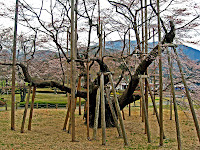
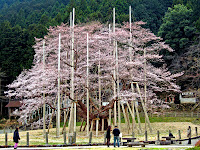
As I mentioned in my post back in January, Gifu houses one of the oldest sakura cherry trees in Japan, 薄墨桜 (Usuzumi-zakura). Usuzumi-zakura is supposedly 1500 years old, only be upstaged by Jindai-zakura in Yamanashi Prefecture which is about 2000 years old. According to legend, it was planted in 467 during the reign of Emperor Yuryaku who was the 21st emperor of Japan. There is some speculation on this, as some websites I've found on it say the year 487.

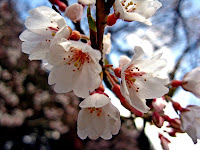
This particular type of sakura is known for it's pale pink petals that fade to white as they reach full bloom, then fade to a light gray as they fall. The name usuzumi-zakura literally translates to "light Chinese ink cherry tree". This name was given due to the fact that the petals do turn a light gray that is very similar to watered down traditional Chinese ink used in calligraphy and painting.


The tree itself is huge compared to the average size of a sakura tree. According to the official website (Japanese only), it is 16.3m (about 53.5ft) tall and 9.91m (about 32.5ft) around it's trunk. The thing is absolutely massive.

Instead of me just typing away about it, how about some pictures to look at?
You can click on them to see them bigger.
Later, once I go through all that I took, I will upload more to my deviantArt site, which is linked to the "Photo" button up top of this blog.

Look how massive that is!

Better look at the supports holding up the massive branches

The blossoms look pink from far away but...

When you get right up to them you notice they're actually white.

Except when the setting sun hits them.

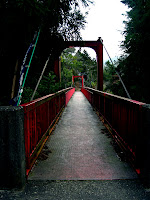
We found a random old footbridge across a dried up river on the far end of the park.

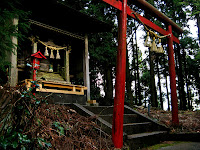
The bridge led through a campsite, up a hill, and to a small little shrine.
The post date for my last entry tells me it's been almost a month since my last post.
And I had promised a post the week after my last one!


All I can say is:
I'm sorry for the wait.

What exactly kept me from posting a new entry?
Well, to put it bluntly, life happened.
The ups and downs that come with life happened to be mostly downs last month, and kept me far away from the computer.


However I am back, and bringing you two new posts today! This post will be a quick recap of several events that have happened in the last month, and the next will be a list of various online resources useful when learning Japanese. Not specifically sites to learn Japanese from, but sites that are good to use as supplements to your learning.


Now, on to the main event! Photos and stories galore!
Those with slow internet connections may want to go get a cup of coffee or go file their taxes while all the photos load up.


First things first, I sadly do not have any awesome pictures of my awesome fiber optic internet line getting installed. The landlord refused permission to have NTT install the line through the wall, so we had to have it brought in through our window. Sadly, it wasn't as awesome of an install as I thought it would be. However, it is relatively faster than my last connection, which is awesome. No lag time in World of Warcraft in the mornings!


In the place of fiber optic installation pictures, I will add to the thousands of photos online of a very peculiar spring festival.

Every March the city of Komaki in Aichi Prefecture, the neighboring prefecture of Gifu who's capital is Nagoya, has a set of shrines that put on a harvest/fertility festival, known as a hounensai (豊年際). These shrines are Oogata Shrine (大縣神社) and Tagata Shrine (田縣神社). Tagata Shrine always has their festival on the 15th, while Oogata Shrine has theirs on the previous Sunday. Oogata Shrine's festival is relatively small and unknown, even though it occurs on a weekend. An image search on Google only brings up 149 hits, very few of which are actually of the shrine. Tagata Shrine, however, brings up 2650 hits. Nearly every single hit is an image of the festival.

I will warn you now. If you are at your place of work, or have young children/immature adults around you, please do not Google search this festival, nor scroll down past here.


This year the two festivals ran together, which I did not know, so I missed out on Oogata Shrine's festival. I dragged my husband to Tagata Shrine early in the morning, hoping to miss the crowd. However, I was dead wrong in my timing.


At only 10am, nearly 3 hours before the actual main events of the festival would start, the temple was already packed.
From the first glance, this looked like any other shrine you'd see in Japan. Typical styled shrine buildings, large stone torii out front, gardens everywhere.
The always-a-must food booths for festivals were also everywhere you looked. We made sure to pick up some yummy Hida Beef ka-bobs, and chocolate-filled taiyaki.


It wasn't until you got further into the shrine grounds, past the taiko drummers, that you notice this is not your typical shrine.
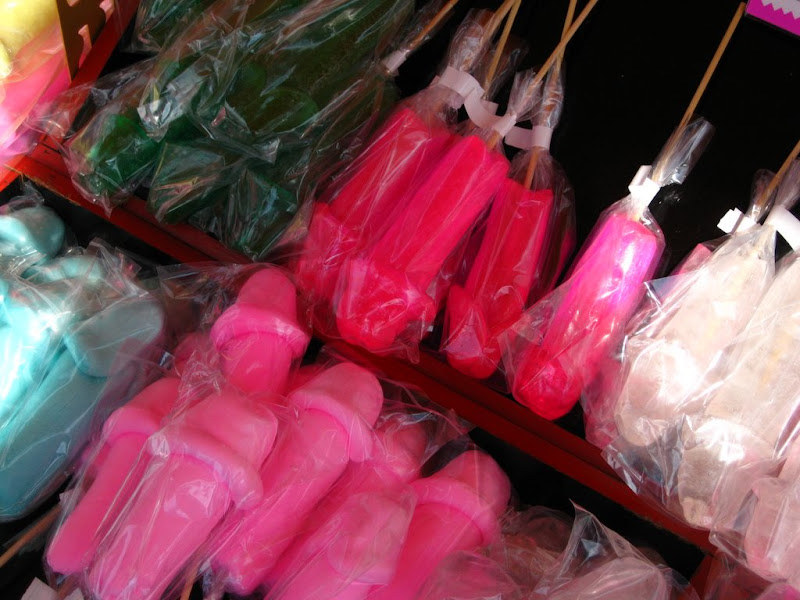
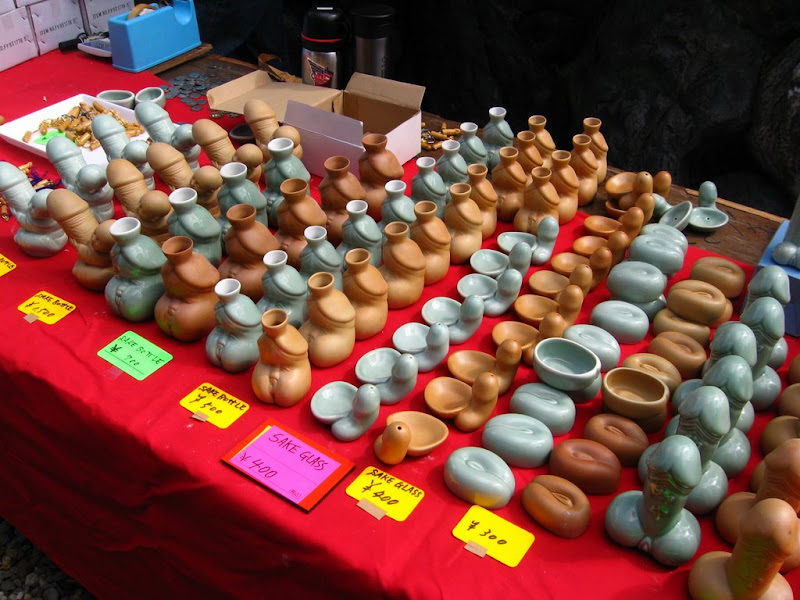
Every where you look are rocks that are phallic shaped. Either naturally shaped or carved by hand, every corner hides several small phalluses. Next thing you know, there are vendor tables selling phallic-shaped candies, ashtrays, incense burners and keychains.


They had phallic candy in several flavors
As well as many different phallic-shaped objects for gifts to take home with you.


As my husband described it, it seemed we had walked into the world's largest sausage fest. But what was the point of all of these phalluses?
Turns out, the deity of Tagata Shrine is a female harvest and fertility deity, and all of the phallic stones, carvings, candy, etc. were gifts and offerings to the deity in hopes for a bountiful harvest and healthy children. Oogata Shrine, the one we didn't get two, houses a male harvest and fertility deity and gets gifts and offerings of female genitalia.


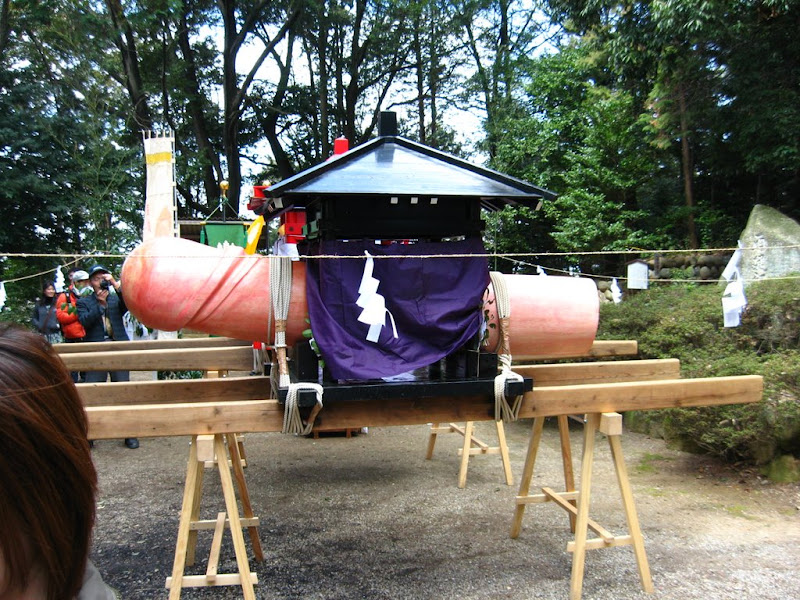
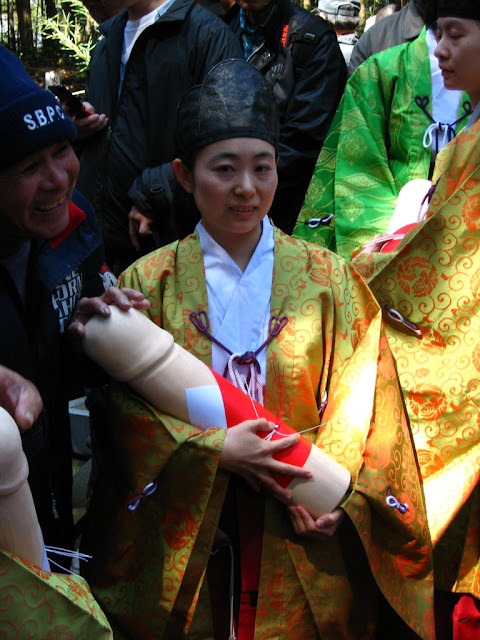
Around 2pm, a parade from the nearby Kumanosha Shrine (熊野社) starts that brings three mikoshi floats to the main shrine of Tagata Shrine. One is an offering float, one is the male deity from Oogata Shrine, and one...I'm not sure what it is, to be honest with you. The offering float contains a newly-carved phallus, made from a single cypress tree. The thing is huge, and sticks out from both sides. There were two or three teams of men, all aged 42 (an unlucky age for men despite being the answer to the ultimate question), who take turns carrying the offering.


The other two floats are a red float, that looks much like a shrine itself, and a elaborate float. The red float, pictured on the left here, carries a statue of Takeinadene-no-mikoto, the deity of Oogata Shrine. Legend has it he was a warrior who married a girl from the village where Komaki now stands. The girl is the deity enshrined in Tagata Shrine, Tamahime-no-mikoto. Sadly, I did not get a picture of the figure inside of this, as much as I wanted to.
The little torii gate in front of the float did make me giggle, though. The Japanese can be very detailed with these things.


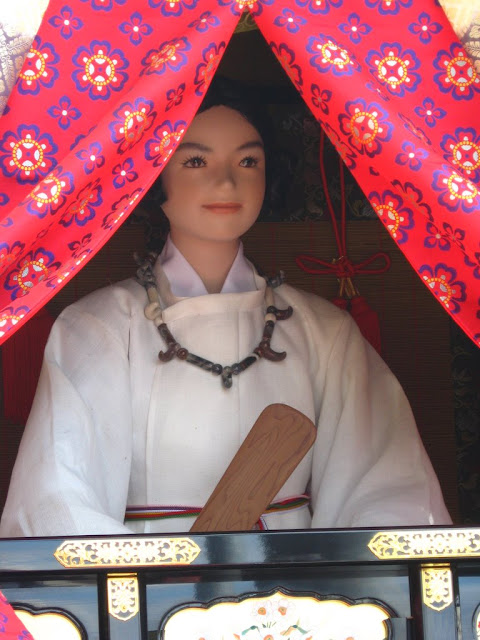
The last float, the really elaborate one held this guy:
No clue who he is. Neither the English pamphlet that I bought for 100 yen nor the informational website I found mentions it. My guess is either it's a second image of Takeinadene-no-mikoto, or the deity of Kumanosha Shrine. If anyone can find any information, I'd love to know!


For all three of these floats, as well as several groups of shinto priests and a group of 36-year-old women holding freshly-carved wooden phalluses (36 is unlucky for women), it takes about an hour to an hour and a half to make the 1.5 kilometer walk between shrines.
Once the mikoshi have made it to Tagata Shrine, the offering mikoshi is brought inside the main shrine, where it will rest for a year until the next hounensai brings a new offering.
Around 4pm there is a mochinage, or rice cake-throwing, where a bunch of the priests and special guests lob lucky rice cakes at the crowd. This is QUITE dangerous, and several times they warned that the elderly, pregnant women, people with kids, and people with eyeglasses should refrain from joining in as the shrine is not responsible for any injuries received while trying to catch a rice cake.

Overall, it was a unique experience, and both my husband and I were glad we went. The festival has gained a lot of popularity with foreign tourists, and a good 30% of the visitors to the festival were not of Japanese decent. There was also a random Japanese man dressed up in full cowboy gear, except for chaps. He also had a guitar case with him, which prompted my husband and I to stay far away from him, in case the guitar case held a machine gun, like the movie Desperato.

If anyone ever comes visit the Nagoya area in March, I completely suggest this festival. I think it's about 700 yen from Nagoya's Meitetsu train station to Tagata Shrine, which makes it a very affordable day trip.
Next year, my husband and I will definitely make plans to go to Oogata Shrine's festival, so I hope this blog sticks around so I have somewhere to post pictures!


Now, there is still one more thing to talk about.
However, I believe this post is long enough, so I will stop here and start a new one. So I guess you guys are lucky and get three posts today!
Almost a month after the move, and I'm still without internet in the new apartment. NTT guys came, landlord said they can't install fiber optic in the walls, so we're bringing it in through the window. You would think that because they don't have to do much installation compared to bringing it up through the walls, that we could get internet quickly. Nope. We don't get the line installed until the 21st. And that will be a fun day as I possibly have classes that afternoon (trial classes that if no one signs up for I don't have to go to!) and the installers might have to deal with my English-only husband. This shall be interesting if I have to go to class and leave him to the insstallers.


And a quick self-promotion (because I just can't help myself), I signed up for a "Dream Photo Shoot" contest. I got the link from The Daily Coyote earlier today and had to sign up. I love photography and would really like to hone my skills one day instead of just taking wannabe photos with a floor model point-and-shoot I picked up cheap at Sears last summer.
Click the badge below and read my dream. And if you are inclined to do so, a vote would be very much appreciated!


Okay, back to work.

Last week I was scheduled to put up a blog on Tuesday, but due to a teacher coming down sick suddenly, I had to take over classes and couldn't get into the office. So you guys get a blog today instead! I was hoping to have more time this month to get in some blogging time, but with the end of the school year, prep for the new school year, TONS of trial lessons, trial students, and starting private lessons for two students on top of my regular classes, I'm pretty much pushed to the limit.

Still, in the hour and a half I have to type right now, I'll try to get in some info about Learn Japanese Free.
While I would say this is a good resource for learning Japanese, I would not make this your main source of information.
It is very simply set up, and easy to navigate. Each topic having it's own link to it's own page. This is the main reason why I say it's a good resource to find information easily.
However, on the very first lesson, Hiragana, there is a major mistake.

Obviously, as there is no explanation of stroke order, this site is designed to help you learn to read and speak Japanese, not write. While the charts of hiragana themselves have no mistakes, and actually cover all of the combinations and diacritical marks making it a wonderful chart to study from, one of their explanations halfway down the page is wrong.
Under the first hiragana chart they list two exceptions to the pronuncation rules they mentioned on the top of the page: one for the subject marker は(ha) and one for the directional marker へ(he). The page has the explanation of " は[ha] is pronounced "wa" when it is immediately follows the subject. It is usually only pronounced "ha" when it is a part of a word" which is correct, but the explantion of へ(he) carries the wrong hiragana.
The website has "ひ [he] is pronounced "e" when it immediately follows a place or direction. Both of these are very simple to detect" as the explanation, but the character listed is ひ(hi) not へ(he). Mixing up ひ and へ is a very common mistake, mainly because how they are pronounced compared to the common romaji reading of both. ひ is pronounced as the English pronoun "he" but is written as "hi" in romaji. へ is prounounced very closely to "hay" but is written as "he" in romaji. Confusing, eh?

The first few lessons of introductions, greetings and intro vocabulary are very, very sparse without much explanation of usage other than definition. While not bad, the last of example sentances or situations to use the vocabulary may be confusing at first. Lesson 4 (vocabulary) includes a link to a second vocabulary lesson. Once again, a lot of useful vocabulary but no explanation, despite having two different words for "this". They also leave out some related vocabulary that is usually taught all at once in most classrooms.

Lesson 5, grammar, is the first page with any real explanations. The page introduced the word order for Japanese sentences, but concentrates more on sentence particles. The main page states that this is a page of minimal grammar points, and boy were they not kidding. While the explanations are easy to understand, there's not a lot said. It's about as minimalistic of an explanation as you can get for the subject markers. If you don't know much about English grammar terminology (like what direct and indirect objects are), you'll be pretty confused.

After this lesson, the order that the beginner lessons continue in doesn't make much sense to me. Instead of trying to tie the learned vocabulary and grammar together with useful phrases (lesson 7), they introduce 16 kanji characters first. Personally, I would have put this AFTER basic grammar, sentence structure, and example sentences have been thoroughly covered and explained. Lessons 8, 9 and 10 give pretty good practice dialogues, except that much of the vocabulary used in the dialogues have not been covered anywhere in the previous lessons. If you have a dictionary on hand this won't be a problem, but for those without, you're on your own for figuring out which word in the Japanese sentence corresponds with the English translation.


Past lesson 10 starts the "intermediate" Japanese lessons, which strangely start with "Basic Japanese Sounds". I don't know about you, but if the title of the lesson contains "basic" it should be under the "basic lessons" section, not intermediate. However, this is by far the best lesson yet. This should have been Lesson 3 right after hiragana and katakana. How you can get this far into teaching Japanese online WITHOUT explaning pronuncation thoroughly is beyond me. If you chose to use this website as a Japanese resource, PLEASE look at Lesson 1 under "Intermediate" before you go to any of the grammar or vocabulary pages. Otherwise you'll get into bad habits of pronouncing things with English pronuncation rather than Japanese. Please, do yourself a favor and learn pronuncation rules before you learn vocabulary. It'll make it so much easier and make you look less like an idiot when you actually try to converse in Japanese for the first time. And just so you know, EVERYONE looks like an idiot the first time they speak Japanese. Learn to laugh at yourself and your mistakes, and move on. I can't begin to tell you how embarrassing it was to get to Japan my first time and realize how horribly my pronuncation was when I first tried to converse.


The rest of the lessons in "intermediate" are things I would consider basic as a teacher. Lesson 2
FINALLY gives detailed explanations of particles, along with examples! It also includes several links to pages detailing Japanese adjectives, pronouns, basic verb conjucations (though this could be more detailed), differences between the verbs "aru" and "iru", the copula "desu", and tenses/politeness forms. The numbers lesson has a few instances where they have the reading for "10" as "jo/joo/jooo" instead of "ju", but is a good start to learning numbers.
Other lessons finally introduce ways to address others, find out names, and also have several links to related topics that may come in handy if dining/shopping in Japan or in Japan on business. Many of the lessons include handy phrases and words you hear often in everyday Japanese conversations.

Overall, a pretty decent basic page. However, there are several mistakes in both the English and in the Japanese throughout the page, so be careful. Out of all the lessons, those in the "intermediate" section are by far the most useful. They offer more detailed information, examples, and cover much more grammar and vocabulary than the "basic" lessons. I wouldn't even consider the basic lessons a "toe in the water" for those wanting to learn Japanese. Other than the hiragana and katakana charts, one could possibly skip over them all and move right into the intermediate lessons, granted they have other sources to learn from as well.

The best pages, by far, of the whole site are the last three links on the page to sites for Japanese songs, downloads (Japanese word processing software and games), and Japanese newspaper sites. If you are really interested in learning more about Japan and Japanese, I totally and completely suggest the four links found here for Japanese newspapers in both English and Japanese. Best way to get an eye into Japan's world from inside Japan from your own home. Many of the newspapers' English sites offer articles written by foreigners in Japan, usually detailing little odd bits of Japanese culture and life that many Japanese themselves don't think twice about.


And while I'd love to write more, especially in detail for the later "intermediate" lessons, I need to run to the grocery store to get dinner stuff before heading to my afternoon classes.
Look for a new blog sometime during the middle of next week!
Well our move it finally well over. We still have a few more things we need to pick up for the new apartment, mainly bookcases and bins to put all the junk we have. How in the world we managed to store all this stuff in my tiny 1-bedroom for two years is beyond me. We have literally three times the amount of space of my old apartment, but nowhere to put anything. I guess we were so used to just stuffing things in boxes in the upper part of my closet to really notice how much stuff we have.

This weekend the NTT guys come to see if we can install fiber optic or not. I can't wait for Saturday to come. I just home the day they want to come and actually install it, myself or my husband will be home. I have a majorly busy schedule next month, so who knows.


I would review a Japanese site today, but am still looking for a good next page to review. I need to start a running list of all the sites out there so I can keep better track. Big sites I'd like to review are definitely JapanesePod101 and About.com's Japanese pages, but I want to get my feet wet with more smaller sites first.


In other words, expect a review sometime next week. Most likely sometime on Tuesday. I'm going to spend the rest of my "blogging hour" searching for a list of websites to review.


I will leave you with one promotional thing. If you are serious about studying Japanese, and are in the market for a good kanji dictionary, I completely and totally suggest The Kanji Dictionary. It's a $70 dictionary that is unique in that you can search for a kanji combination (i.e. kanji that comprises of two or more kanji) by ANY kanji in the word. Most make you search by only the first kanji, but if you're not sure on the radical can be difficult. My friends got me this for my 17th birthday and I have now taken it to Japan three times and used it constantly in my college studies. It also has many useful appendices in the back, such as a conversion chart for Japanese calendar years, diagrams of Japanese school and political systems, and many maps of the country.
For those not willing to plunk down $70 on a dictionary, they make a smaller Learner's Dictionary version, usually for $25. My university's Japanese department had several of these for student use. While they don't have as much as the $70 version (they lack a lot of older, rarely-seen kanji), they are still just as useful and as easy to use.

I still prefer to use my big, fat, heavy, can-bash-someone's-head-in $70 dictionary to look up kanji combinations than my designed-for-Japanese-people electronic dictionary. So much easier to use, in my opinion. I wouldn't trade this dictionary in for the world. My first year here in Gifu I thought I lost it, and it heartbroke me, until I went home and found it in a box of stuff I moved out of my old room at college when I graduated. It promptly went back into my suitcase back to Japan.


As I think of more books and dictionaries that I think are useful in studying Japanese, I'll be sure to post links. If I had access to more Japanese textbooks other than the one I used in college and the one I use to teach my husband, I'd also do textbook reviews.
Moving in Japan is always an adventure. Luckily, I was able to get it all done with quite painlessly and quite quickly.

My husband and I got our keys on the 6th and had everything moved out and cleaned up by the 13th, turned in the keys that morning and we were done. AND we should be getting most of our security deposit back. I have to ask the boss exactly how much it was because that dictates how much I'll owe on the new apartment's security deposit.

Only complaints about the new apartment are that it lacks a "washlet" toilet seat (i.e. heated toilet seat that also had butt-washing sprays), and there are no windows in the room we use for our bedroom. However, the latter isn't much of a problem considering if we open one of the sliding doors we get plenty of sun in from the next room over, our living room.

One day, once we get Internet access, I'll post picture of the new place compared to the last. I'll also post pictures of the NTT guys installing fiber optic Internet (yeah, you know you're jealous).


Other news, I completely bombed my Japanese Language Proficiency Test (JLPT). I took the highest level with no studying whatsoever just to see how horrible I'd actually do. Amazingly, I got just around the 40% I thought I would be lucky to get. Only 30% more to go until I pass. Let's see how well I do this coming December!


Anyway, onto the main course! Today, I'll be reviewing a random website I found at work, Free Japanese Lessons.


First impressions: Much, much simpler front page compared to the last website. Straight forward links to all available 10 lessons, videos, chat, and the FAQ. Not flashy, but very straight-forward and easy to navigate. Only downside is the abundance of ads around the front page, but even then they aren't very intrusive. I like the "Today's Kanji" and "Today's Phrase" boxes on the upper right. The link to information about hotels in Japan is also convenient and not something I've seen on many other sites.


Obviously a beginner's website, the first lesson they offer dumps you right into hiragana with a chart of all hiragana, including those with diacritical marks and combinations. It has a short but concise explanation of pronunciation, which with everything considered is actually a pretty decent explanation. Japanese pronunciation isn't that hard once you realize that vowels will never change how they sound no matter what comes before or after them in the word.
A major point for this particular lesson, which I don't think I've ever seen explained on the same page as a hiragana chart, is the pronunciation exceptions for the characters は and へ ("ha" and "he" respectively). Most wait until certain grammar points are learned to bring up the pronunciation exceptions for these two characters, but this site puts it right out there are the beginning to try to defuse any confusion down the line. They also offer a neat little explanation on why these two have second pronunciations, an explanation I actually did not know myself. I was always told in my learning that they are sometimes pronounced differently because "that's just how Japanese is". Their explanation actually makes sense and makes me mutter なるほど (that explains it) under my breath.
They also include the standard explanation of why there are two "zu" and "ji" characters, and also a brief thing on how to know when to use them. All in all, a decent intro to hiragana. Only thing missing is stroke order, which is very important when learning to write. Due to there being no stroke order explanation, I'm guessing this site is more geared towards reading and speaking Japanese, rather than writing.

The next lesson brings you to katakana, which just like hiragana offers nothing but a chart. Also, the explanation about how katakana is used for foreign names and borrowed words is not entirely correct. Yes, katakana is used for foreign names and borrowed words, but it is also used for scientific names of animals and plants, and often as almost a replacement for italics in writing when emphasis is needed/wanted by the writer. However, it is a decent explanation if you're looking for a short-and-to-the-point explanation.

Moving on, we have vocabulary. We're given a very spartan list with a very loose organization. 23 words, including words for "you", "I", "him", "her", "this/that", "here/there", greetings, and random nouns (person, cat, dog, house). While these are all really good things to know, they aren't presented in an easy-to-remember format. Just a list. A list with the kanji, hiragana, romaji, and English meaning. The site does try to explain that there are different types of formalities when dealing with greetings, and offers both forms of "thank you" and "good morning". However, they only offer the casual form of "goodbye", さよなら (sayorana). Formally, it should be さようなら (sayounara).

Lesson 4 brings on grammar, and once again we're looking pretty spartan. The whole page is nothing but explanation about particles, which while are an essential part of Japanese grammar, it is kind of different to see the main 5 listed all together right off the bat. Also, they don't even go into much explanation about へ (e) as a particle. Once again, very basic, very to the point explanations about the remaining four particles, but perhaps too basic. Part of me hopes they go into more details of the particles and how to figure out what is the topic and what is the subject and all that. They do mention that "I" is usually dropped from the sentence in spoken Japanese, due to being implied. This is something many textbooks do not teach, as textbook writers want to make Japanese grammar closer to that of English.

Fifth lesson on the page makes me wonder if the person making this site is just winging it and creating lessons as he goes along. We go from vocab, to grammar, back to vocab. And of all things, numbers, time, days of the weeks and months. Considering how basic this vocabulary is, I would have put it directly after Lesson 3 with the greetings and other basic vocab. Once again, a very spartan list, and instead of listing out a good portion of the numbers, time and months, they give you the start of the "pattern" and tell you to run with it. While they do explain that "4" and "7" both have two pronunciations, they don't go into detail about why you shouldn't use the one pronunciation of "4". For those curious, "4" can be pronounced よん or し ("yon" or "shi"). The pronunciation of "4" as "shi" is avoided a good 60-80% of the time as "shi" also means "death". Because of this, "4" is also an unlucky number. My old apartment complex and my new apartment complex both do not have rooms or parking spots ending in "4". So the first floor rooms go 101, 102, 103, 105.

I really don't have any complaints about the days of the week part of the page. It's straight-forward and simple enough even without a thorough explanation.


Now, back to grammar. Lesson 6 starts off with verb conjugations right away, specifically those of godan verbs. Godan verbs are verbs that the verb stem changes depending on the tense. There are five stem changes, hence the "go" or "five" in the name of the verb type. This site actually sets up their explanation much like my high school sensei did, which for me made it very easy to understand. Only complaint about the whole page is how they explain the conjugation of "te" and "ta" forms. It would be easier to understand with a second chart, rather than just text.
Next lesson continues verbs with ichidan verbs, and once again only gives simple explanations of the conjugations. In their simplicity, the explanations are slightly confusing. They try to compare ichidan verbs with godan by giving them five "bases", or stems. Technically, only have one stem, hence the "ichi" for "one" in the name "ichidan". In their attempt to connect new material with what has already been learned, they actually make it a bit more confusing than it would have been to just introduce them as having only one base, not five. Personally. I would have introduced ichidan verbs first, then godan. But that's me.
Also, their "five base" system of organization they have going on here makes it a bit confusing for the only two irregular verbs in the language. Only really useful thing on this page is a small link to verbs that sound like ichidan verbs but are actually conjugated like godan verbs.


Earlier on, I believe in Lesson 4 or 5, it was mentioned that polite tenses would be discussed in Lesson 8. Well, not really. Yes, they list the polite forms of different verb conjugations, but that's about it. No explanation on when to use them or anything. Also, while they give an explanation for each verb tense, they don't give any examples of how to use them in sentences. And come to think of it, I haven't even seen any explanation about the copula, です (desu) at all. Usually that gets explained way before verbs ever do.

Lesson 9's explanation of adjectives is a bit confusing as well. Not sure where they got "dv" and "dn" for the two types of adjectives in Japanese, but it's something new to me. They mention how "dv" adjectives (commonly called i-adjectives in many textbooks) can be used as adverb and modify nouns, but give no explanation further than that. No examples or anything. They do, however, show how "dn" adjectives (commonly na-adjectives) can be used as adverbs.

Lesson 10 leaves us off at how to introduce yourself to someone and other common phrases. The further I get into the site, the more I start to not like how simple it is. Simple is good, but there are places where it does need more explanation on grammar points. Keeping it too simple misses out on a lot of subtleties in Japanese grammar that need more time and attention.


Overall, a good start to a website. I hope it eventually starts developing into a fuller website, but at this point I'm not keeping hopes up. It's a good place to dip your feet it and get a brief overview of what you're in for when you actually buckle down and start studying Japanese for real.


And that's it for this time. End of this month the NTT guys come on the 28th to check out what they have to do to get fiber optic into the apartment, so hopefully by middle of next month I'll have home access again! Not sure what website I'll do next time, but I'm always up for suggestions.
This week my husband and I move out of our dinky 1K apartment into a nice, spacious 3DK about 5 minutes away. As such, it's been a busy week of prep, and this week we've been moving things back and forth between the two places every day. Tomorrow, movers come for the last of our big stuff (fridge and washing machine), and by Friday we have to be completely out of the 1K and have it cleaner that it was when I moved in two years ago in hopes of getting my security deposit back. I doubt I'll get all of it back, but I'm hoping for a bunch of it back.


Look for another review post up sometime next week. Not sure what page I'll be doing, but look for it anyway.


Till then.
Finally, here we are at the true purpose of this blog: introducing and reviewing "learn Japanese" websites.


Today we'll start with The Japanese Page (TJP).


First, I want to say I am using the office's laptop to view this page, and it won't let me update IE to 7, nor will it play nice with Firefox. I blame my boss for never running an anti-virus on here, so if what I say seems to be different than what you see on your own computers, I apologize in advance.


First impression of the main homepage is cluttered. I seriously don't know where to start. First, half the page is taken up with an ad from the main supporter of TJP (a Japanese pen pal website) . It's a giant text promotional ad calling people to buy a membership to the pen pal site. Takes up a large part of the screen, and runs into the next part of the site. Not sure if it's an introduction to the site or an ad for reading a story in Japanese while listening to it being read in Japanese. Looks like both together.

There's also a login box, a sign up box for a newsletter, a poll, links to articles, ads everywhere, a shoutbox, a list of top posters, etc. And it's all meshed in with poorly placed ads. I can't tell what image is a link to an article and which is an advertisement. One also has to scroll to the bottom of the page to find links to articles separated by level. There are links to the normal website fare of a chat, forum, videos, audio and the like up top, but that's the only thing I find useful on the entire front site.


Clicking on the FAQ link, one has to scroll through rules for the forums before even getting to the main FAQ. However, the FAQ is easy to use, once you get to it, and offers help on how to install the necessary files to both read and type in Japanese on your home computer. It also offers, if you scroll though, some good links to find downloadable audio files and pen pal sites. There are some basic questions about Japanese that are answered in the FAQ, but they don't seem to fit into the section of the FAQ where they are placed.


As for the site's lessons page, this may be the page set up the best on the entire site. Lessons are listed in order of Beginner, Grammar, Kanji, Culture, Vocab, General and fun stuff. It's set up really simply and is easy to figure out what is what, but is it all beginner level stuff? What happened to intermediate and advanced? Does the website not offer those? One may never know from just looking at this page. Clicking on the Beginner link, the beginner "lessons" are no more than a collection of flash cards, video and audio clips explaining simple grammatical concepts or vocabulary, and downloadable podcasts. There seems to be no real set path, no "Try this first" or "Do this next". One just starts with whatever one wants to, it seems. The New to Japanese Advice page gives some hints at where to start, what textbooks you might want to consider, and some reasons to learn Japanese, and finally at the very end it gives a "Try this next" link. There is no real guidance or rhythm to the page or the lessons, but instead encourages visitors to log in and join in the forums, where you can talk to other learning Japanese from TJP and other means, and possibly find help. There are some good links to other sites for resources, but nothing concrete.

Following the link to their 15 Minute Japanese Lesson, however, does give a good introduction to the basics of the language, even if all at once. It's a good page to see what you're getting yourself into, but once again doesn't lead to anywhere. The Japanese Page leaves it completely up to the learner to decide what order and how they want to learn. While this can be beneficial for those who like learning things sporadically, this can be detrimental as learners have no real path to follow in learning. Once you learn how to read and write Hiragana and Katakana, where do you go to learn basic grammar? What if you don't care about reading and writing, but need to get some basic conversation skills down for when those Japanese visitors at work come by next month? There doesn't seem to be any real flow.

The Hiragana and Katakana pages, however, are quite well set up. They break the two writing systems into chapters to make them easier to learn than cramming them all at you at once. It also has sound files to hear how each character is supposed to be pronounced so you can practice mimicking the sounds yourself without guessing what they're supposed to sound like. There are also quizzes and flash card links (only on the Hiragana page) that one can use to test themselves. Overall, the set up of these two pages can be very useful in learning and mastering two of the writing systems in Japanese.


Moving onto the Grammar page, while the Lessons page lists four categories of 3kyuu Grammar (What happened to 4kyuu?), 100 Grammar Points, Word Order, and Particles, clicking on the link to the main page just gives a long, uncategorized list of the available "articles" and lessons within the grammar section of the website. There are two large image links for the 100 Grammar Points section and the 3kyuu grammar section that actually aren't that bad. The 100 Grammar Points is split into 8 chapters, and each chapter is further split into 12-13 subsections, many of which do have some sort of relation between themselves. The 3kyuu page, however, is a bit lacking and is just one long list of links, with no real organization it seems.

Out of all the pages up until now, the Hiragana and Katakana pages were set up the best, by far. However, the Kanji section definitely blows them out of the water. The top of the page offers links to a "Kanji-a-Day node and a Kanji Dictionary via TJP, as well as a small link menu to different sections of the Kanji page. While the link menu is slightly confusing, it's easy to skip over and scroll to the main gist of the site, the kanji lists for all four levels of the Japanese Language Proficiency Test. Levels 4 through 2 offer a list of all the kanji in that level, different subcategories of kanji (usually containing 20 kanji each), quizzes on each set of 20 kanji, a PDF file of all the kanji, a randomizer and flashcards. Level 4 also offers a test on all 80. Sadly, the Level 1 page is unfinished, and only offers about 80% of the kanji required for that level of the proficiency test.
Back at the main Kanji page, under the link to the 4 levels of kanji, there are several useful links, such as stroke order, kanji of Japanese origin, reversible kanji combinations, and country names in kanji. All of these actually can be very useful and are probably one of the best things the whole website has to offer.

After the Kanji page, nothing else lives up. The Vocabulary page is just like grammar, and offers just a giant list of different articles in no particular order. While there do seem to be some useful articles, you might have to search and read through several non-related things before finding what you want. Same with the Culture page. While there is a lot of information, some of which is quite interesting, there's just no order. General Lessons just seems to combine a little bit of everything, mainly from the vocab and culture pages. The Fun page just seems to be a conglomerate of everything that didn't fit into the other pages of "lessons". It does have some quizzes and unusual-but-useful vocab lists, but is mainly just...stuff.


Glancing at the Video page, this may also be up there on the same level as their Kanji page was. Videos are arranged in order of level or subject, with several continuing series of videos. Each section also has three videos shown so you can get a brief idea of what each section involves, making it a bit easier to navigate. However, those with slower computers, such as this laptop, may be in for a wait while all the videos load up. The Audio section offers some audio-only versions of several of the videos, as well as audio files of different traditional songs mentioned throughout the website. There are also links to some Beginner-only Podcasts, and several audio lessons. I'm intrigued mainly by the list of traditional folktales they have for download. These wouldn't be a bad thing to download for real listening practice.


For those who create an account on the site, there are also member-run study groups, forums to ask for advice and help, and user-posted blogs. The groups seem to be their own forum where only members of that particular group can post. They're more to bring people at the same stage of learning together rather than help, it seems. While there are thousands of members in several of the groups, the group with the highest post count only has 34 posts. Seems the action is all in the forums, which, frankly, I am afraid to wander into. I will let you guys decide on that for yourselves.


As a Japanese teacher, I think this site does have a lot to offer, but the set-up is lacking in organization and flow. The kanji lists are useful, and the audio files may be a great way to practice listening skills, but there just doesn't seem to be enough meaningful content. Most of the content seems user-created and is frankly quite amateur. There are other places to get the same information, but more up-front and easier to use.

All in all, I say it's a confusing site to start with, and a confusing site to look for resources. If I had to give it a grade, I'd say no more than a C. It has potential, but is to confusing and tries to do too much all at once with no order whatsoever.